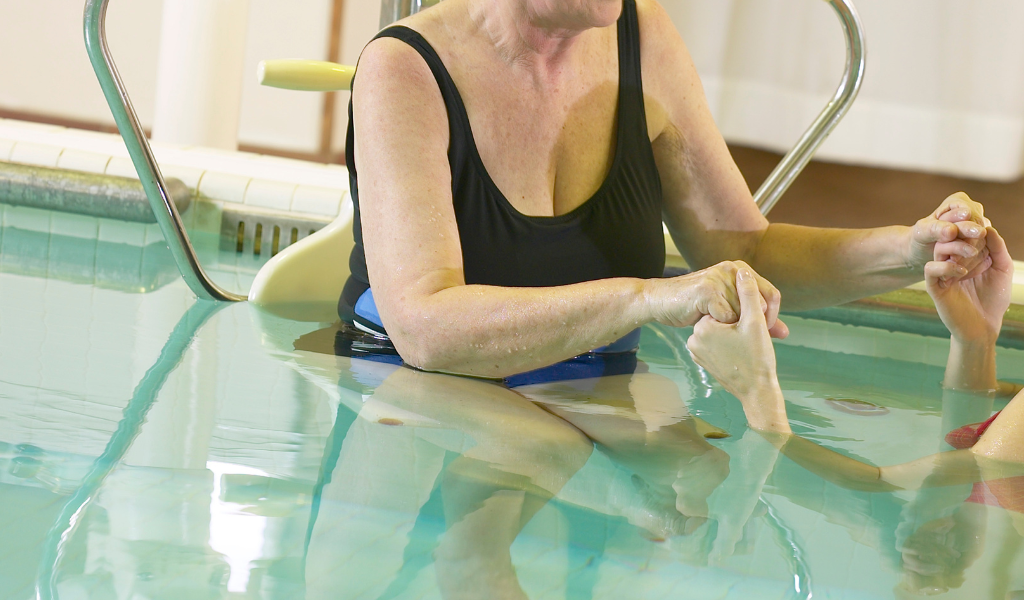
Physiotherapy
Physiotherapy is a branch of medicine that aims to restore patients to a normal state following trauma, illness, or surgery. Rehabilitation can be performed in a private practice or clinic, equipped with treatment tables, a gym, and a designated exercise area, or in water, or even better, in a fully equipped pool.
Water physiotherapy
 Since there is no gravity in water, we don't perceive our body weight. Therefore, patients with functional limitations, obesity, or simply advanced age will be able to feel more independent in an environment like a pool or the sea. In fact, in water, we perceive that some seemingly difficult movements can become easier, thanks in part to the buoyancy that will lift us upward.
Pathologies most suitable for aquatic physiotherapy
Cardiovascular and respiratory conditions are certainly the most beneficial because blood circulation, breathing rate, and movement are facilitated, allowing those unaccustomed to physical activity to move more easily. However, in water, we encounter resistance that can be used to train or rehabilitate the body. It helps us stay afloat, allows us to be aware of the surrounding space, and therefore trains our coordination and body awareness.
Post-surgery physiotherapy
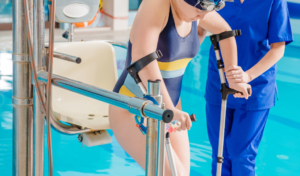 Water's resistance can be exploited to create and invent a variety of exercises aimed at strengthening muscles. For example, following lower limb surgery, patients lose their independence and the ability to walk, so water can be an excellent tool for re-educating patients to return to this physiological activity. The important message is not to recommend aquatic physiotherapy as a fundamental part of the rehabilitation process; rather, we must be aware that, as terrestrial animals, accustomed to gravity, we need to rehabilitate in our natural habitat.
If post-surgical physiotherapy were performed entirely in water, the patient might experience difficulties, for example, when returning to a sporting activity outside of the water. If the opposite were true, there would be no harmful consequences, but modern physiotherapy thinking does not suggest any contraindications to aquatic physiotherapy, but rather guidelines that should be followed as much as possible. Therefore, a hypothetical patient could easily complete part of their rehabilitation in water without experiencing any consequences.
Water physiotherapy, we recommend:
- Check that the pathology that afflicts us is suitable for aquatic rehabilitation.
- Do a comorbidity check
- Have no open wounds or post-surgical stitches
- Have no acute infections or inflammations
- Walk in deep water if you have obesity, a sedentary lifestyle, swollen ankles, impaired venous return, cardiovascular, and respiratory problems.


Via Donatello 75
00195 Rome
Tel. (+39) 06 39375719


Mon. – Fri. 8:00 – 20:00
Saturday 8:00 – 14:00

Via Donatello 75
00195 Rome
Tel. (+39) 06 39375719
Mon. – Fri. 8:00 – 20:00
Saturday 8:00 – 14:00